

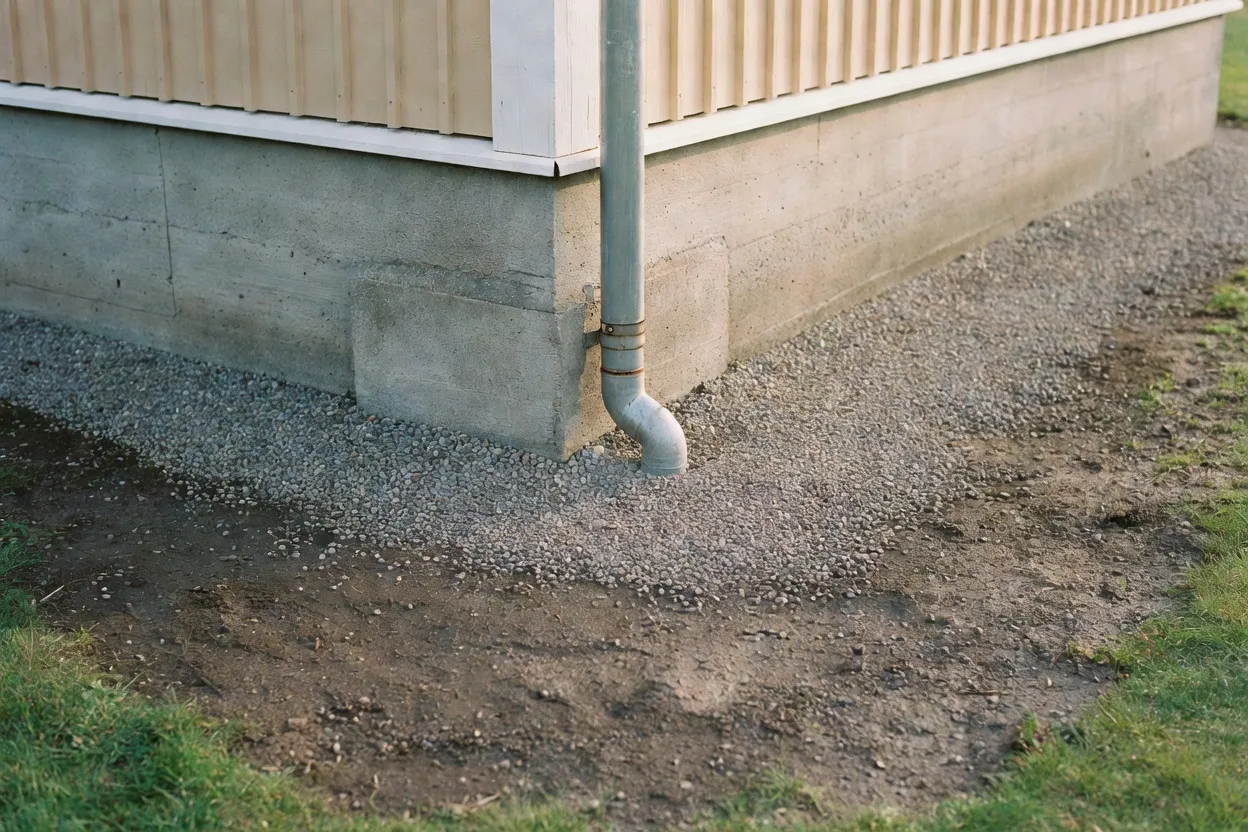
Foundation and drainage: lifespan and cost
The foundation holds the house up and the drainage keeps water away, and it is moisture at the bottom that causes the most expensive damage. The table shows how long the parts last and what a fix usually costs.
The ranges apply to a normal-sized house. Actual cost depends on size, access and region. Lifespan means technical lifespan with normal upkeep.
| Component | Lifespan | Replacement cost |
|---|---|---|
| Concrete foundation | 100 yrs (80-150) | 300 000-800 000 kr |
| Drainage | 35 yrs (30-40) | 100 000-300 000 kr |
| Crawl space | 80 yrs (50-100) | 200 000-500 000 kr |
| Slab-on-ground | 100 yrs (80-150) | 300 000-800 000 kr |
How long does drainage last?
The concrete foundation itself is nearly permanent, but the drainage around the house is a wearing part that needs redoing at intervals. When it stops leading water away, moisture rises in the foundation and basement. Signs are damp or salt on the basement wall and water pooling near the house. See the dedicated page on drainage for when it needs redoing.
What does redoing the drainage cost?
Redoing the drainage means the ground is dug up around the house, new drainage and moisture proofing are laid against the foundation wall and the soil is filled back. The price is driven by how deep it is, how close the house sits to the plot boundary and shrubbery, and whether the ground slopes. Crawl spaces and slab-on-ground have their own risks and fixes. The cost in the table applies to a normal-sized house.
What the age of the house tells you
Some build years carry known risks for exactly these parts. Here are the most common ones.
Blue concrete (radon risk) Houses built 1929–1975
The build year does not establish the presence of blue concrete or the radon level. Check the measurement report.
Slab on ground - moisture in sole plates Houses built 1960–1985
9 out of 10 houses from this era have a foundation with insulation on top of the slab, which leads to moisture problems.
Crawl space with moisture problems Houses built 1950–1999
Crawl spaces from this era often have insufficient ventilation and ground moisture barrier.
How do I know if the drainage needs redoing?
Ask for the year of the last drainage work. Damp, a musty smell or salt deposits on the basement wall and water pooling against the house are signs it is no longer doing its job.
Is a crawl space a risk?
Crawl spaces from certain years often have poor ventilation and ground moisture barrier and can develop mould. Checking smell and moisture in the crawl space is part of an inspection; see the age note below.
Related
Terms used here
Heimer does this for you
Paste a listing and get the monthly cost, the risks and what to check.
Analyse a home See a finished analysis