

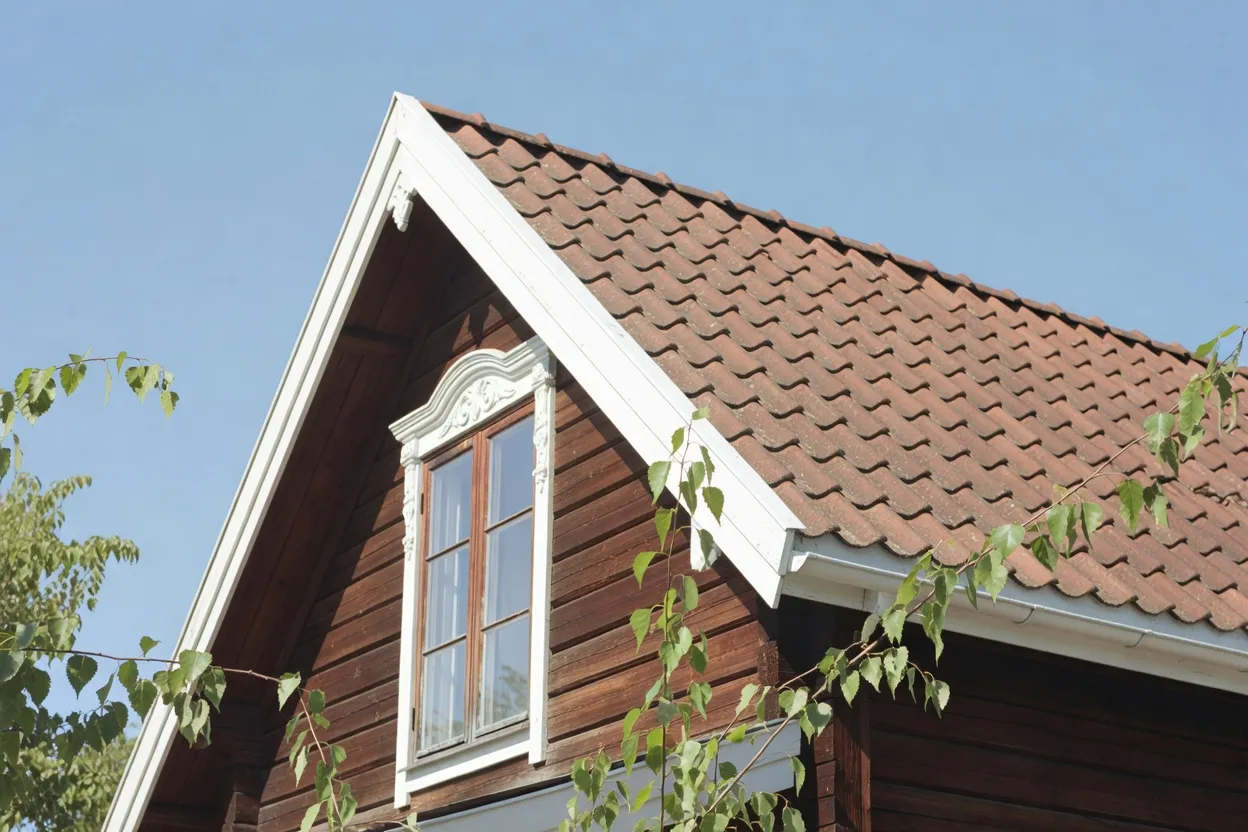
Risks in a Swedish house built before 1950
The main risks in a house built before 1950: radon from blue concrete, asbestos and old wiring. An old house is not the same as a bad house.
Updated: 2026-06-02
The three things worth the most attention in a house from this era are radon from blue concrete, asbestos in older materials, and an ungrounded electrical system. The rest of this page is things you tick off calmly, not things you need to be afraid of.
And the most important point first: an old house is not the same as a house in poor condition. Many pre-war houses are solidly built and in fine shape. It is simply that certain things come with the period and are therefore worth looking for. Once you know what you are looking for, it becomes a list to tick off, not a cloud of worry.
Blue concrete and radon
Blue concrete (blåbetong) is a blue-grey lightweight aerated concrete that was made between 1929 and 1975. The material contains a raised level of radium, which decays and gives off radon gas, and roughly 400,000 Swedish homes are affected. It is most common in Stockholm, the Mälardalen region, Gothenburg and Västerås.
Worth knowing: a raised radium content does not automatically mean high radon levels indoors. Ventilation plays a big part, and the only way to know is to measure. The reference level for radon in homes is 200 Bq/m3, and action should be taken if the level is exceeded.
What you check:
- Ask for a radon measurement report (radonmätningsprotokoll). A proper long-term measurement is done during the heating season.
- Look for blue-grey lightweight concrete in the walls.
- Note whether earlier measurements showed values above 200 Bq/m3.
What it usually costs: a common fix such as a radon sump or improved ventilation often lands around 15,000-50,000 kr. Removing the blue concrete entirely is a bigger job and can cost considerably more, but that is rarely needed.
Asbestos
Asbestos was banned in Sweden in 1982, so expect that it may be present in materials in houses built up to then. It was found in, among other things, eternit (asbestos cement) on roofs and facades, in floor tiles and sheet flooring, in sealants and grout, and in pipe insulation.
The reassuring part here is that asbestos is generally harmless as long as the material sits undisturbed. The risk mainly arises during renovation, when material is broken up and dust is released. So treat material from before 1982 as suspect, and plan for sampling before you tear into it or drill.
What you check:
- Eternit sheets on the facade or roof.
- Grey or black floor tiles.
- Older pipes with white insulation.
What it usually costs: asbestos removal often falls in the range of 50,000-300,000 kr, depending on where it is and how much needs to be taken out. If you do not need to renovate those parts, it is usually not urgent.
Ungrounded electrical system
Wiring from this era often lacks grounding, and the cabling is frequently undersized for how much electricity a modern household draws. That can create both a fire and a shock risk, so it is worth looking at early.
What you check:
- Screw-in fuses (the old plug fuses) in the fuse box.
- Two-pin sockets with no grounding.
- Whether there is no residual-current device (earth-leakage breaker).
What it usually costs: a rewire or upgrade of the electrics often falls in the range of 50,000-200,000 kr, more if the whole house needs rewiring. An electrical inspection (elbesiktning) gives you far firmer ground than a hunch at the viewing.
Other things to tick off
These are common age and condition questions for the period. They are rarely dramatic on their own, but good to have a handle on.
| Risk | What you check | Approximate cost |
|---|---|---|
| Inadequate ventilation | Ask for the OVK report, check whether windows have been replaced without ventilation work | around 80,000-250,000 kr |
| Basement with damp problems | White salt deposits, damp patches, a mouldy smell, flaking paint | around 100,000-350,000 kr |
| Poor ground-floor insulation | Draughts at the skirting boards, low energy class | around 50,000-150,000 kr |
| Energy-hungry construction | Check the energy class, ask for past heating costs | varies with the house |
| Chimney stack with cracks | Ask whether the chimney stack is approved by the chimney sweep | varies |
| Cast-iron drains | Ask whether relining or replacement has been done, and whether there have been blockages | varies |
A short orientation on a couple of these. Natural-draught ventilation (självdrag) was built for leakier houses, and often works less well after windows have been replaced and the house has been further insulated. Older basements often lack modern drainage (dränering) and a moisture barrier, so damp can rise through floors and walls. Cast-iron drains rust from the inside and have a lifespan in the order of 50-70 years, so in a pre-war house it is reasonable to ask whether they have been replaced.
What you do
- Ask the agent for the radon measurement report, the OVK report and any electrical inspection in advance.
- Book your own surveyor (besiktningsman), and ask them to look especially at the electrics, damp in the basement, and ventilation.
- Treat all material from before 1982 as possible asbestos until a sample says otherwise, especially if you are planning to renovate.
- Ask for past heating costs so you see the real monthly cost, not just the price.
- Add up the work you actually intend to do in the first few years, and fold it into what the house costs to own.
Terms to know
Home prices by city
Price per square metre in every district.
Common questions
Is a house built before 1950 always in poor condition?
No. Age and condition are not the same thing. Many pre-war houses are solidly built and in fine shape. The things that come with the period, such as radon, asbestos and older wiring, are things you check off calmly, not signs that the house is bad.
How do I know if the house has dangerous radon levels?
The only way to know is to measure. Blue concrete (blåbetong, a lightweight aerated concrete) can give off radon, but a raised radium content does not automatically mean high levels indoors, because ventilation matters a lot. Ask for a radon measurement report. The reference level is 200 Bq/m3, and action should be taken if it is exceeded.
Do I have to remove asbestos straight away if I buy the house?
Usually not. Asbestos is generally harmless as long as the material sits undisturbed. The risk mainly arises during renovation, when dust is released. Treat material from before 1982 as suspect and take a sample before you tear into it or drill.
What does it cost to fix an old electrical system?
An upgrade or rewire often falls in the range of 50,000-200,000 kr, more if the whole house needs rewiring. An electrical inspection (elbesiktning) gives you firmer ground than guessing at the viewing, and shows how much really needs doing.
When was asbestos banned in Sweden?
Asbestos was banned in 1982. So expect that it may be present in materials in houses built up to then, for example in eternit (asbestos cement), floor tiles, sealants and grout, and pipe insulation.
What should I ask the agent at the viewing?
Ask for the radon measurement report, the OVK (ventilation inspection) report, any electrical inspection and past heating costs. Also ask whether the cast-iron drains have been replaced, whether the chimney stack is approved by the chimney sweep, and whether there has been damp in the basement.
Know what to investigate
Find out what needs investigating. Bring questions about this particular home to the viewing.
Analyse a home See a finished analysisRead next
- Era risks in Swedish homes: what the build year says about hidden defects A home's build year predicts which hidden defects are worth checking, from blåbetong and radon to damp and facades. A calm checklist by decade.
- Home inspection and hidden defects: what to check before you buy in Sweden What a besiktning covers, how long you can hold the seller liable for hidden defects, and what you must check yourself. Plain answers for buyers.
- Risks in a Swedish house built in the 1950s A 1950s house is not worse for being old. Here are the risks to check: blue concrete and radon, asbestos and old wiring, calmly and step by step.