

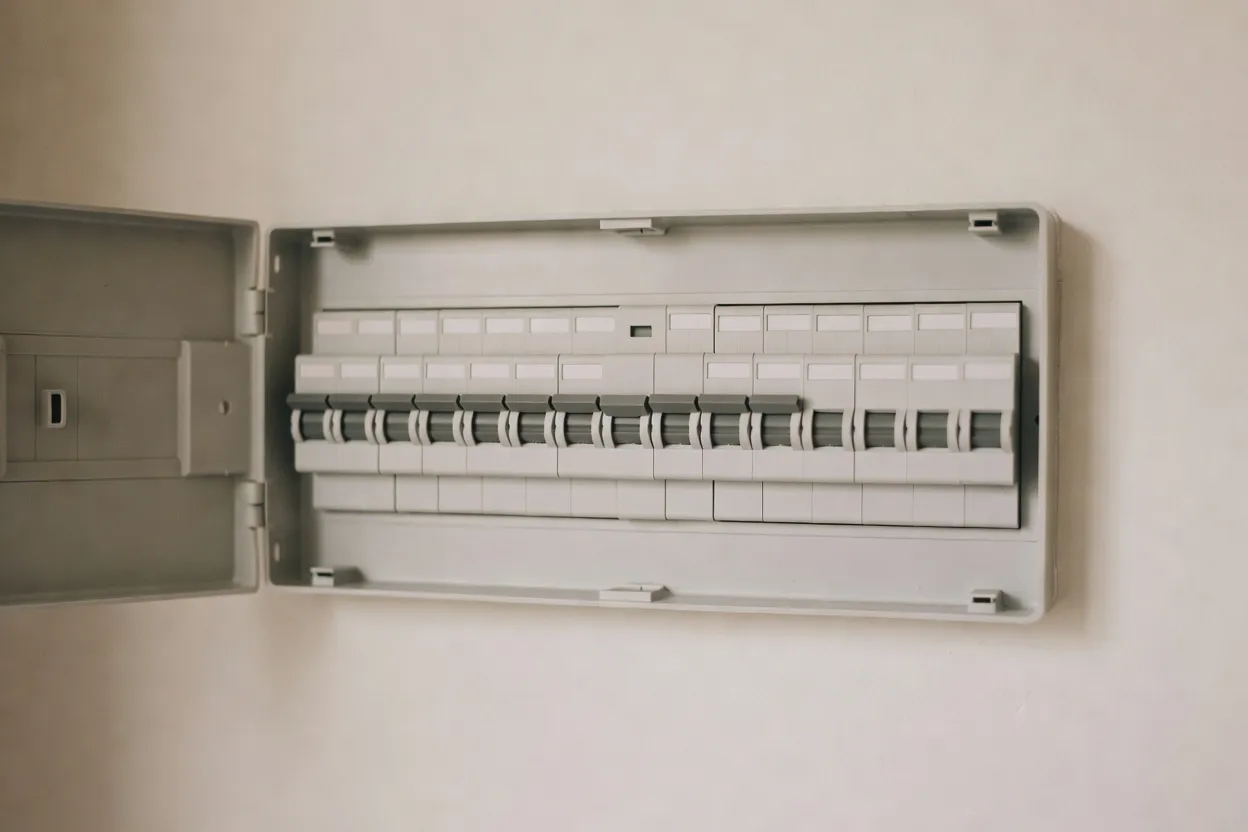
Electrical: lifespan and cost
The electrical system is a safety question as much as an upkeep one. The table shows how long the parts last and what an upgrade usually costs.
The ranges apply to a normal house. Actual cost depends on size, access and region. Lifespan means technical lifespan with normal upkeep.
| Component | Lifespan | Replacement cost |
|---|---|---|
| Consumer unit | 40 yrs (30-50) | 25 000-70 000 kr |
| Electrical wiring | 50 yrs (40-70) | 80 000-250 000 kr |
| Sockets and switches | 40 yrs (30-50) | 15 000-50 000 kr |
| Residual current device | 25 yrs (20-35) | 3 000-10 000 kr |
When does the wiring need replacing?
Wiring lasts a long time but the insulation grows brittle over the years, and old installations often lack the earthing and residual-current devices required today. A house with its original consumer unit and old screw fuses rather than circuit breakers is nearing an upgrade. Sockets and switches are cheap to replace as you go; the consumer unit and wiring are the larger item.
What does rewiring cost?
Replacing the consumer unit is a contained job, while rewiring a whole house means opening walls and costs more. A residual-current device is cheap and raises safety the most of anything, and if it is missing it should be the priority. The cost in the table applies to a normal house.
What the age of the house tells you
Some build years carry known risks for exactly these parts. Here are the most common ones.
Old fuse box (screw fuses) Houses built 1900–1975
Screw fuses and an old installation — consider an upgrade and an RCD.
Aluminium wiring Houses built 1965–1977
Aluminium wiring from this period — check joints for overheating.
Post-war reconstruction house (material shortage) Houses built 1945–1955
Reconstruction-era house — simple build standard, often due for an upgrade.
Must all the wiring be replaced in an older house?
Not always. If the wiring is sound and earthed, updating the consumer unit and adding a residual-current device may be enough. An electrical inspection decides what is needed, and it is cheap relative to the peace of mind.
What is the difference between screw fuses and circuit breakers?
Screw fuses are the older technology and are swapped when they blow; circuit breakers reset with a flick. A consumer unit with screw fuses is a sign the system has some years on it.
Heimer does this for you
Paste a listing and get the monthly cost, the risks and what to check.
Save a home for free See a finished analysis